During the lesson we were given an example of a Teenage drama (Skins), for which we commented on the representation.
extract- http://www.youtube.com/watch?v=Shjkid9qw3Y
Of course this being a teen drama, it's audience is clearly targeted at young adults. This being so, the audience needs characters to whom they can relate and recognize similar personalities in reality; such as the geek or school nerd, the popular guy/girl, the rebel etc... These are examples of characters stereotypically that may be displayed in teen dramas.
In the extract given the main characters are obviously of an age group close to that of the audience, again, to make the characters relatable for the audience. The location or situation displayed in the extract involves what seems to be a night club, which is a location associated with the audience watching further maintaining their attention. The gender types in the extract are obviously a combination of male/female, however there is a shot within the sequence of a female participating in the fight part of the extract, going against the stereotypical portrayal of females to be the weak figures who aren't expected to be the participants of a fight as much as observers. In terms of the class and status of the group of adolecents in the extract, seem to come from families with a standard income judging from the decoration of the area where the party is being held, and the costume worn, which doesn't appear to be particularly expensive.However the fact that a venue such as the one shown in the clip is the location of this party shows that the family/parents can afford to pay for such a venue, therefore aren't in a grave financial problem.
Wednesday, 5 December 2012

Wednesday, 21 November 2012
Significance of Lighting & Colour
The Hedgehog (Le Hérisson)
I thought throughout this film there was a strong use use of indoor natural lighting as well as artificial, to replicate the probable lighting of a Parisian apartment. The characters of Paloma and Madame Michelle discover similarities between them. Paloma is a girl who feels trapped into a destiny she doesn't want to realize, and Madame Michelle lives a quiet unnoticed life hiding herself from the world, behind the shadow of a widowed janitor, until their paths cross.

It seemed to me that in all shots of Madame Michelle's apartment, the lighting used is very obviously artificial and high-key as you would expect it to be, it appears to make her skin very pale and tired looking, except for when we finally discover her "hiding place" which is her personal library. In this particular room, there is the use of the diagetic & low key lighting of a single lamp. This light is very warm looking as you can see from the movie still above, which is quite a significant change compared to the other areas of her apartment. I see this room as being the heart of Michelle's character. This is the place she comes to to hide from the rest of the world (like the hedgehog she's compared to by Paloma) to be herself through reading about other worlds. The use of low key lighting reflects her reluctance to share much of her secret place to others, simultaneously as showing the small yet strong glowing warmth of her true, elegant character that is costumed in prickly spikes and unseen by most people. It also gives her apartment for once, an actual warm, homely feel.
Becoming Jane
I picked this movie to briefly analyse for lighting as I felt, whilst watching it- the brightness was one of they key aspects that I liked about it and that stood out to me my first time watching the film.
In general, I thought the lighting was designed to replicate that of a natural, rural environment in the English country side through the use of diagetic lighting, as this is where Jane Austen lived during the age she is presented in the movie. As a result the bright and raw looking lighting seemed to also brighten the characters faces and highlight rosy refreshed faces living in such a peaceful and country area. There was also quite a repetative use of low key lighting creating an effect of light and shadow in many of the scenes. However, although the lighting remains fairly natural throughout the movie, at certain points in the movie particularly when the characters are going through something emotionally difficult the brightness of it seems to depict a cold and still atmosphere rather than the simple fresh atmosphere of the country side of Hampshire- the colours of the clothing play a vital role in this as well.
Clip extract 1- Insult of the smiling face
http://www.youtube.com/watch?v=NnEKQD1fS20&feature=channel&list=UL
Within this scene, the audience is led to believe the lighting source are the candles scattered around the room and centre piece to the table. However it seemed to me, that there is a use of overhead lighting here, due to the unusual brightness of the guests at the table in contrast to the other areas of the dining room. The purpose of this could be to replicate the probable other source of lighting in the scene- perhaps a chandelier, but also to draw attention to the guests at the table. I think this attracts the eye naturally to their faces through the use of low-key overhead lighting and therefore to the conversation and reactions of each character to one another. Also, after watching the special features of this movie, it is mentioned by the costume designer how the colour choices for the costume were made to stand out or at least not blend in with the background colours, further drawing the viewers attention to the characters and maintain their visual interest.
Clip extract 2 - Jane and Tom Elope
http://www.youtube.com/watch?v=OOMIZUsKlmg&feature=relmfu
I thought there was great significance within this clip of lighting, particularly the section of the extract where the sun is rising as the characters Jane and Tom run away. Although the time of morning they eloped would make sense realistically, the way the director has chosen to have the diagetic light source of the sun in the shot sequence shows significance of the two lead characters- Jane and Tom having another chance at being togther, as previously there was a scene potentially desroying all hope the audience had, and now the sun is symbolism for that hope rising again. It also shows quite a transition between the lighting within the Austen house and the lighting outside where "the love of her life" waits. During the sequence of shots where Jane is seen packing her belongings there is quite a lot of shadow in contrast to the bright and hopeful lighting of the following sequence. The fact that the sun is so bright, results in almost a silhouette outline of both characters as they run away, creating a very romantic use of back lighting.
I thought throughout this film there was a strong use use of indoor natural lighting as well as artificial, to replicate the probable lighting of a Parisian apartment. The characters of Paloma and Madame Michelle discover similarities between them. Paloma is a girl who feels trapped into a destiny she doesn't want to realize, and Madame Michelle lives a quiet unnoticed life hiding herself from the world, behind the shadow of a widowed janitor, until their paths cross.

It seemed to me that in all shots of Madame Michelle's apartment, the lighting used is very obviously artificial and high-key as you would expect it to be, it appears to make her skin very pale and tired looking, except for when we finally discover her "hiding place" which is her personal library. In this particular room, there is the use of the diagetic & low key lighting of a single lamp. This light is very warm looking as you can see from the movie still above, which is quite a significant change compared to the other areas of her apartment. I see this room as being the heart of Michelle's character. This is the place she comes to to hide from the rest of the world (like the hedgehog she's compared to by Paloma) to be herself through reading about other worlds. The use of low key lighting reflects her reluctance to share much of her secret place to others, simultaneously as showing the small yet strong glowing warmth of her true, elegant character that is costumed in prickly spikes and unseen by most people. It also gives her apartment for once, an actual warm, homely feel.
Becoming Jane
I picked this movie to briefly analyse for lighting as I felt, whilst watching it- the brightness was one of they key aspects that I liked about it and that stood out to me my first time watching the film.
In general, I thought the lighting was designed to replicate that of a natural, rural environment in the English country side through the use of diagetic lighting, as this is where Jane Austen lived during the age she is presented in the movie. As a result the bright and raw looking lighting seemed to also brighten the characters faces and highlight rosy refreshed faces living in such a peaceful and country area. There was also quite a repetative use of low key lighting creating an effect of light and shadow in many of the scenes. However, although the lighting remains fairly natural throughout the movie, at certain points in the movie particularly when the characters are going through something emotionally difficult the brightness of it seems to depict a cold and still atmosphere rather than the simple fresh atmosphere of the country side of Hampshire- the colours of the clothing play a vital role in this as well.
Clip extract 1- Insult of the smiling face
http://www.youtube.com/watch?v=NnEKQD1fS20&feature=channel&list=UL
Within this scene, the audience is led to believe the lighting source are the candles scattered around the room and centre piece to the table. However it seemed to me, that there is a use of overhead lighting here, due to the unusual brightness of the guests at the table in contrast to the other areas of the dining room. The purpose of this could be to replicate the probable other source of lighting in the scene- perhaps a chandelier, but also to draw attention to the guests at the table. I think this attracts the eye naturally to their faces through the use of low-key overhead lighting and therefore to the conversation and reactions of each character to one another. Also, after watching the special features of this movie, it is mentioned by the costume designer how the colour choices for the costume were made to stand out or at least not blend in with the background colours, further drawing the viewers attention to the characters and maintain their visual interest.
Clip extract 2 - Jane and Tom Elope
http://www.youtube.com/watch?v=OOMIZUsKlmg&feature=relmfu
I thought there was great significance within this clip of lighting, particularly the section of the extract where the sun is rising as the characters Jane and Tom run away. Although the time of morning they eloped would make sense realistically, the way the director has chosen to have the diagetic light source of the sun in the shot sequence shows significance of the two lead characters- Jane and Tom having another chance at being togther, as previously there was a scene potentially desroying all hope the audience had, and now the sun is symbolism for that hope rising again. It also shows quite a transition between the lighting within the Austen house and the lighting outside where "the love of her life" waits. During the sequence of shots where Jane is seen packing her belongings there is quite a lot of shadow in contrast to the bright and hopeful lighting of the following sequence. The fact that the sun is so bright, results in almost a silhouette outline of both characters as they run away, creating a very romantic use of back lighting.
Saturday, 17 November 2012
Short Action Film- Filming Diary
Day 1 of Shooting
Shots filmed : 2
Camera Woman: (Me), Victoria
Use of: Steady Cam
As this was our first time filming, it was expected (for me) from the beginning of the day that we wouldn't get many shots recorded. However we managed to completely finish our detailed storyboard, sort out character roles as well as prepare ourselves properly for efficient filming thanks to Mr. Wall and Mr. Lucas. We automatically opted to shoot from the beginning section of our script, which made sense also for the reason that that shot in particular was short and achievable in the short amount of time we had. Also this was our "official" first time with the camera so we were still learning how to work it in addition to the correct film terms to use. Despite this I think its safe to say we all felt pleased with the shot we got and it pretty much matched what we wrote into the story board.
Day 2 of Shooting
Shots filmed: 2
Camera Woman: Keeley Burridge
Use of: Steady Cam
We planned to do more during this filming session than we managed to, however we were told that this is a natural problem that arises during all or most filming productions. There were two factors that affected this; one- we wanted to achieve as close as possible to what we had in mind so it took some time getting the shot exactly how we wanted it and two- at the beginning of the lesson I think we were quite disorganised. We decided at the start to shoot other scenes to what we ended up shooting, but this is only because what we intended to shoot involved class rooms and there were no appropriate classrooms available at the time, therefore as a result we lost around twenty minutes of our filming session. The shots that we achieved I think were exactly what I, at least pictured in my mind, and my group members were pleased with the result as well. We actually. got to incorporate a specific technique we learned during the production day- focus of camera. The effect we achieved focus on the texture of the carpet as well as the shoes moving within the frame, I thought this added an aesthetic point of interest compared with the second shot, which was solely focused on the shoes. As we learned on the production day, focus is one of a few basic camera adjustments directors use to capture the attention of the audience, or focus it on a specific area of a frame.
Day 3 of Shooting
Shots filmed: 5
Camera Woman(en): Cary Banks/Keeley Burridge
Use of: Shaky Cam
I would agree that this filming session was the most successful so far as we planned in advance exactly what shots we were going to film and decided to take advantage of the wet whether conditions, in addition to saving time finding a class room and simply using the window of our classroom to film, as this was all we really needed and would not affect the continuity of the film when we'll film in another room later on. One of two shots were successful for the establishing shots we filmed, which was quite difficult to manage as half our group was outside and we somehow needed to communicate when we would shoot; so we created colour cards to signal to one another- which were really useful, and without which the process of filming would've been much slower. As with the other shooting sessions, we confirmed the shots we would be shooting using our story board, and then discussed the shot we would use and the movement of the camera. It was during this session that we began to strongly consider the use of shaky & steady cam and which would really be more appropriate for an action film. I think this session was also successful in the sense that we were following our story board, yet the conventions of an action film were slipping from our minds, this session was sort of a wake up call in terms of conventions, which we've become more aware of now. We also put into practice, the use of zoom in an impulsive shot, which I thought was really successful It will also give us a variety of shots to choose and alternate between, thus later reflecting one of the conventions of an action film we researched- a fast editing pace.
Day 4 of Shooting
Shots flimed:5/6
Camera Woman(en):Lorna Edwards/Keeley Burridge
Use of: Shaky/Steady Cam
First part of idalogue- Lorna/Vicky
Clock/corridor
We managed to move onto filming the first part of our dialouge scene this filming hour.
We also impulsively added in more shots to prolong the arrival of one of the lead characters in order to create tension. This theme alone, we thought, runs strongly through any action movie that we've come across. We portrayed this theme through a shot of a clock ticking to show the passing of time, which makes the audience more aware of how much time has passed, making its passing seem longer thus creating tension.
Day 5 of Shooting
Shots filmed: 3
Camera Woman: Keeley Burridge
Use of: Shaky Cam/Steady Cam
During this filming session we were around about the middle of the dialogue part of the scene. However I hadn't worn the required clothing for the scene being filmed, and this did pose some problems as to what we could shoot, nevertheless our group was successful in dealing with this problem by filming the dialogue of the other lead character where we put the conventional low angle shots into use, and the standard over the shoulder shots. However, looking back on it now, I think the continuity of our piece was affected as the room layout was different to the filmed in last time, and I think we also made the mistake by filming over the wrong shoulder. In a series of over the shoulder shots one subject must be filmed from the right and the other from the left, or else the series will create the a sense of confusion as the camera's line of perspective will not be straight but diagonal. Towards the end of the session, we decided impulsively (again) to add in shots for a flash back sequence (which we discussed, however did not draft into a final version of the story board), as they would not only enhance the narrative but also add in some actual action- the flashback was of one of the lead characters running and a shooting taking place. I think these shots were crucial as they are what make our project an action film.
Day 6 of Shooting
Shots filmed: 4
Camera Woman: Keeley Burridge
Use of: Steady Cam
We decided to film during our free time as we had fallen behind scedule, unfortunatly though to of our members weren't available to shoot, so we shot what we could without them. We finished the flash back sequence shots as well as getting more crucial dialogue shots.
Shots filmed : 2
Camera Woman: (Me), Victoria
Use of: Steady Cam
As this was our first time filming, it was expected (for me) from the beginning of the day that we wouldn't get many shots recorded. However we managed to completely finish our detailed storyboard, sort out character roles as well as prepare ourselves properly for efficient filming thanks to Mr. Wall and Mr. Lucas. We automatically opted to shoot from the beginning section of our script, which made sense also for the reason that that shot in particular was short and achievable in the short amount of time we had. Also this was our "official" first time with the camera so we were still learning how to work it in addition to the correct film terms to use. Despite this I think its safe to say we all felt pleased with the shot we got and it pretty much matched what we wrote into the story board.
Day 2 of Shooting
Shots filmed: 2
Camera Woman: Keeley Burridge
Use of: Steady Cam
We planned to do more during this filming session than we managed to, however we were told that this is a natural problem that arises during all or most filming productions. There were two factors that affected this; one- we wanted to achieve as close as possible to what we had in mind so it took some time getting the shot exactly how we wanted it and two- at the beginning of the lesson I think we were quite disorganised. We decided at the start to shoot other scenes to what we ended up shooting, but this is only because what we intended to shoot involved class rooms and there were no appropriate classrooms available at the time, therefore as a result we lost around twenty minutes of our filming session. The shots that we achieved I think were exactly what I, at least pictured in my mind, and my group members were pleased with the result as well. We actually. got to incorporate a specific technique we learned during the production day- focus of camera. The effect we achieved focus on the texture of the carpet as well as the shoes moving within the frame, I thought this added an aesthetic point of interest compared with the second shot, which was solely focused on the shoes. As we learned on the production day, focus is one of a few basic camera adjustments directors use to capture the attention of the audience, or focus it on a specific area of a frame.
Day 3 of Shooting
Shots filmed: 5
Camera Woman(en): Cary Banks/Keeley Burridge
Use of: Shaky Cam
I would agree that this filming session was the most successful so far as we planned in advance exactly what shots we were going to film and decided to take advantage of the wet whether conditions, in addition to saving time finding a class room and simply using the window of our classroom to film, as this was all we really needed and would not affect the continuity of the film when we'll film in another room later on. One of two shots were successful for the establishing shots we filmed, which was quite difficult to manage as half our group was outside and we somehow needed to communicate when we would shoot; so we created colour cards to signal to one another- which were really useful, and without which the process of filming would've been much slower. As with the other shooting sessions, we confirmed the shots we would be shooting using our story board, and then discussed the shot we would use and the movement of the camera. It was during this session that we began to strongly consider the use of shaky & steady cam and which would really be more appropriate for an action film. I think this session was also successful in the sense that we were following our story board, yet the conventions of an action film were slipping from our minds, this session was sort of a wake up call in terms of conventions, which we've become more aware of now. We also put into practice, the use of zoom in an impulsive shot, which I thought was really successful It will also give us a variety of shots to choose and alternate between, thus later reflecting one of the conventions of an action film we researched- a fast editing pace.
Day 4 of Shooting
Shots flimed:5/6
Camera Woman(en):Lorna Edwards/Keeley Burridge
Use of: Shaky/Steady Cam
First part of idalogue- Lorna/Vicky
Clock/corridor
We managed to move onto filming the first part of our dialouge scene this filming hour.
We also impulsively added in more shots to prolong the arrival of one of the lead characters in order to create tension. This theme alone, we thought, runs strongly through any action movie that we've come across. We portrayed this theme through a shot of a clock ticking to show the passing of time, which makes the audience more aware of how much time has passed, making its passing seem longer thus creating tension.
Day 5 of Shooting
Shots filmed: 3
Camera Woman: Keeley Burridge
Use of: Shaky Cam/Steady Cam
During this filming session we were around about the middle of the dialogue part of the scene. However I hadn't worn the required clothing for the scene being filmed, and this did pose some problems as to what we could shoot, nevertheless our group was successful in dealing with this problem by filming the dialogue of the other lead character where we put the conventional low angle shots into use, and the standard over the shoulder shots. However, looking back on it now, I think the continuity of our piece was affected as the room layout was different to the filmed in last time, and I think we also made the mistake by filming over the wrong shoulder. In a series of over the shoulder shots one subject must be filmed from the right and the other from the left, or else the series will create the a sense of confusion as the camera's line of perspective will not be straight but diagonal. Towards the end of the session, we decided impulsively (again) to add in shots for a flash back sequence (which we discussed, however did not draft into a final version of the story board), as they would not only enhance the narrative but also add in some actual action- the flashback was of one of the lead characters running and a shooting taking place. I think these shots were crucial as they are what make our project an action film.
Day 6 of Shooting
Shots filmed: 4
Camera Woman: Keeley Burridge
Use of: Steady Cam
We decided to film during our free time as we had fallen behind scedule, unfortunatly though to of our members weren't available to shoot, so we shot what we could without them. We finished the flash back sequence shots as well as getting more crucial dialogue shots.
Thursday, 1 November 2012
Some Production Day Quotes
" I am the teller of the tale, not the creator of the story"
-British Director
" Meaning is limited by the tools we have available." - G.Wall
"You can make a bad film from a good script, but you can never make a good film from a bad script"
-G. Wall
Some quotes which I thought would be relevant during the filming of our short movie, and that I found quite interesting.
Significance of Sound (Atonement)
I personally found this movie to be quite a let down (plot wise), I was about a quarter of the way into the movie when I thought of turning it off. However, what prevented me from doing this was the interesting use of Mise-en-Scene, Shots and Sound. Despite the unbelievably depressing story line, my eyes were captivated by the methods the Director (Joe Wright) and co used to portray this story. The sound was a large part of this portrayal, and arguably for me- the most successful.
Throughout the entire movie, the sound and various other factors presented this theme of motion; in the sense that, every time an event occurred which would later result to be the cause of the unfortunate future of these characters, the background music began to play. It would always begin softly by that one recurring note, then two layers could be heard and it built up until you heard this polyphonic texture of musical sounds, resembling a wheel spinning faster and faster- spinning the fates of the characters into reality as a result of small mistaken actions. A motion which could not be stopped or undone.Another interesting use of sound was the typewriter, which comes back in snippets at certain parts of the movie. It is fist evident in the beginning of the movie.
Before I launch into further explanation of my two points- I decided to make a list of all the introductory sounds only within the first two minutes of the film, which you may compare to the link of the clip below.
http://www.youtube.com/watch?v=nqjEXD0T5Lo - Part 1
Atonement: Initial Sounds
-Nature sounds (birds etc...) Diagetic
-Typewriter (being wound up) Diagetic
- " "
- Typewriter typing, in sync with letters of movie title appearing on the screen Diagetic
- After establishing shot, the direction from which the typewriter sound is coming changes. As camera approaches the typewriter, sound grows louder to the same level of volume to what we heard in the opening credits. Diagetic
- Nature sounds continue- buzzing of a wasp singled out from those sounds Diagetic
- Music begins- single reccuring note, all other sounds continue Non- Diagetic music
- Page is pulled out from typewriter, and placed in a folder Diagetic - 2 musical layers are now heard Non- Diagetic
- From now on the musical layers build up, entwining with typewriter sounds to provide a rhythm.
(analysed until 2:01 mins in the clip)
These sounds not only support the reality of what is occurring in the visual frames we see before us, but also can foreshadow the future of what will occur in the story- only to be evident once the film is finished.
For example:
- The typewriter sound is used (as I have already said) in certain parts throughout the entire film. The first we hear of it, is when the typing sounds are in sync with the letters of the title appearing on the screen. At the very end of the movie we discover that the little girl (Bryony) has been driven to write the truth about the events that happened during that summer onward as a result of guilt, through the medium of a book. This book is entitled "Atonement". When the sounds are typing out the title in the initial two minutes of the film, this could reflect Bryony beginning to write her novel. And as the typewriter sounds return throughout the movie, this could also reflect the events being written into her book as we see them happening on screen.
- We hear the sound of a wasp, buzzing against the window in the room, in the initial two minutes of the film also. This wasp sound is heard again at around 6: 18/6:19 mins into the clip above. The sound attracts Bryony's attention to the window, causing her to see something which she understands in the wrong way- this is one of the misunderstandings that causes an unfortunate future for both the characters seen by Bryony, later causing Bryony to feel guilty for her childish mistake.
- Finally, as I have mentioned before;the polyphonic musical theme repeats itself along with the typewriter throughout certain parts in the movie. This presents the theme of motion as a means of reflecting the fates of the characters being constantly altered for the worse as a result of misconception. It presents the course of fate to be unstoppable through the theme of motion, only constantly progressing and spinning faster and faster into reality. The way music can reflect the theme of motion can also be supported by action within the frame at certain points. Below there is a link to part two of the film. I noted that when the character "Robbie" touched the water the spinning musical motif began again, to perhaps show that what had just occurred was an event that would weave their fates into unfortunate futures. Note how after this shot, there is the same shot of Bryony closing the window, as evident in the part 1. The musical layers thicken at the same time as they thickened in part 1 when her eyes flicked upward in the reflection in the mirror.
My explination may appear confusing, this is only because the film is constructed of two perspectives of each event that Bryony misunderstands- her view (the way she saw it) and reality (the way it really occurred). The sound is a support tool used to tell both stories and evoke certain themes/emotions- for which I thought "the theme of motion" was the most relevant. This shows how sound can be used effectively in film. "Atonement" I believe is a perfect example.
Key Terms learnt
Diagetic Sound - Sound that placed in order to appear that it is coming from the world of the film, for example- a girl walks into her room, closes the door and turns on her cd player- the noises created by her movement, the closing f the door and the sound of the cd player are all diagetic sounds coming from the world the character on the screen is in.
Non-Diagetic - Sound that is placed in the film for the purpose of adding to the atmosphere. The viewer knows that this sound does not come from the world of the characters on screen, this tends to be a musical score/soundtrack.
On Screen Sound - Diagetic sound that is coming from a source that can be seen in the frame on screen.
Off Screen Sound - Diagetic sound that is coming from a source that cannot be seen in the frame on screen e.g. the sound of a car crash whilst the camera films the character's reaction to this inside their house.
Parallel Sound - Sound that fits the action occurring on screen e.g. a fast paced song, heavy on guitar playing in a scene of a car chase.
Contrapuntal Sound- Sound that is the wrong fit for what is happening on screen. e.g. a positive pop song during a battle on screen.
Tuesday, 30 October 2012
Significance of Mise-En-Scene (Costume)

Jacqueline Durran for "Atonement" -
A lot can be said about this signature costume piece for the movie "Atonement". At first glance (outside of context) an audience may already be able to tell that it is an evening item of clothing through the material and overall cut of garment (length in particular). The aesthetic properties of the material immediately reveal that silk is the main component. As this is a fabric usually connotes to wealth and has expensive qualities, it can also reveal the wearer's social status to be associated with upper class . This probably is more evident within the context of the film, where the character of Cecilia who wears this garment, is filmed inside an expensive looking building. The hair and accessories of this character further support that "Atonement" is a period film; Cecilia wears a hairstyle called "finger weaving" which was extremely popular during the 1920's and 30's, particularly in evening wear. The waves appear sleek and precise also reflecting the evening attire, as opposed to being worn quite loose by Cecilia earlier on in the movie during "day" scenes. Lastly I'd like to mention the role of colour of the garment. According to an interview with Jacqueline Durran (costume designer for this movie) conducted by the magazine Harper's Bazaar, the brief given was "It has to be green and it has to be good". The reason for the colouring was to reflect the jealousy felt by another character for Cecilia. In my perspective "Atonement" is a very emotionally driven film, and jealousy is one of the key emotions that intertwines with the future of the characters. Therefore I can understand the choice of the representation of jealousy through this garment.
The cut of the dress was "designed to be a barely-there dress, with its bare back and thin straps" (to quote Jacqueline), this was for the purpose of being a metaphor of the "heat that physically and psychologically dominates the film".

Deborah L. Scott for "Titanic"
This is one of the many outfits in Titanic that managed to win the designer- D.L. Scott awards for best costume. It provides us with a first impression of the character of Rose, which is a vital costume to get right in movie production, so I believe. The style of the outfit informs the audience that this is a period film, regardless of whether they can identify the exact time frame solely from the costume. The statement hat, fashionable suit and parasol support this in addition to Rose being an upper class character, also evident from the arrival in a car which was a luxury for those who could afford it at the time. The suit that Rose wears was the height of fashion at this period in time, when masculine clothing only just begun to seep through into women's wardrobe. The high waist line was also a trend, thus further informing the audience that Rose is a character who can afford to be fashionable. To go more in depth in reference to the choice of pattern, the stripes could be used to reflect one of the key aspects of the character. Stripes resemble bars of prison cells, thus reflecting this idea explored in the film, of Rose being trapped to lead a life she doesn't want for herself. Simultaneously the stripes and choice of colour for the outfit resemble nautical clothing, and at the time (1912) dressing for the occasion was another luxury and opportunity to flaunt wealth amongst the upper class society.
Danilo Donati - "Romeo & Juliet" {1968}
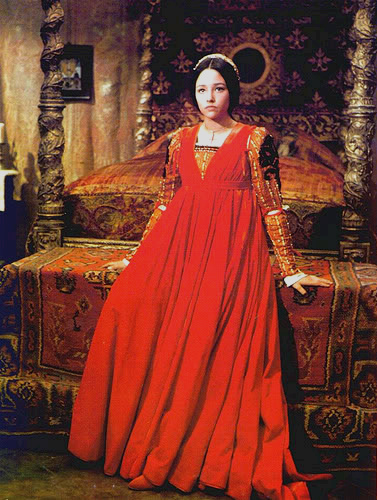
 Juliet appears in this crimson gown for the first time to be seen by Romeo, at the masked ball in the house of Capulet. This colour can cover most of the dominating emotions of Romeo & Juliet: It symbolises the future passion between R & J, the sacrifice of themselves to one another,the danger of their relationship to their own lives ans finally the hate of the two families. I think the most obvious connotation to this colour in this context is the foreshadowing of the love between Romeo & Juliet. Also Donati uses very rich fabrics for this costume thus informing us that the family of Capulet is of noble blood and wealthy. In terms of the importance of character I noticed that throughout the movie Juliet and Lady & Lord Capulet are really the only characters who wear a bold shade of red, which signifies that they are the main members of the Capulet family, some of the main characters in the movie and also directly related to each other. Whilst Lady & Lord Capulet wear a deeper tone of red, Juliet is seen in this photo to be wearing a really bright shade, probably to reflect her youthful age and potential for love. Within the ballroom scene, Romeo wears a blue outfit. Later on in the movie during the marriage of the two lead roles, you may note the theme of the colour lilac in both their outfits. Despite the fact that it's not a deep shade of purple it's still within the hue, and can be perceived to reflect the union of R & J through marriage. Lastly I'd like to mention the significance of religion in Juliet's attire in this photo. Not only does the jewelled Christian cross she wears support her Christian faith, but again the crimson red also. According to Wikipedia "Red is the liturgical colour for the feast of martyrs, representing the blood of those who suffered death for their faith" which could possibly be echoed through Juliet's clothing to resemble the same blood suffered by her for her faith in her true love for Romeo.
 Kym Barrett - "Romeo & Juliet" (1996)
In complete contrast to the representation of Juliet in the 1968 version, Kym Barrett dresses this version of Juliet in a white angel like costume as evident in the photo on the left, although the connotations to religion and faith are just as strong. I think in this 1996 representation, Juliet's innocence is highlighted through the angelic connotations of her costume. The colour not only depicts innocence and religious faith, but also vulnerability. In this sense vulnerability and innocence could be presented as reasons for her falling in love so quickly. Despite the different representations there are some similarities; for example the "halo" worn in this version as a hairstyle and in the previous version as a golden head piece adorned with small red crystals.Another similarity that both Juliet's share is the Christian cross worn as a necklace. Overall this costume depicts a young and innocent girl as opposed to the other representation of Juliet as the same young girl only less focused on her arguable innocence than her ability to love Romeo. Personally I find the 1968 version of Juliet most accurate through costume.
This is one of the many outfits in Titanic that managed to win the designer- D.L. Scott awards for best costume. It provides us with a first impression of the character of Rose, which is a vital costume to get right in movie production, so I believe. The style of the outfit informs the audience that this is a period film, regardless of whether they can identify the exact time frame solely from the costume. The statement hat, fashionable suit and parasol support this in addition to Rose being an upper class character, also evident from the arrival in a car which was a luxury for those who could afford it at the time. The suit that Rose wears was the height of fashion at this period in time, when masculine clothing only just begun to seep through into women's wardrobe. The high waist line was also a trend, thus further informing the audience that Rose is a character who can afford to be fashionable. To go more in depth in reference to the choice of pattern, the stripes could be used to reflect one of the key aspects of the character. Stripes resemble bars of prison cells, thus reflecting this idea explored in the film, of Rose being trapped to lead a life she doesn't want for herself. Simultaneously the stripes and choice of colour for the outfit resemble nautical clothing, and at the time (1912) dressing for the occasion was another luxury and opportunity to flaunt wealth amongst the upper class society.
 Kym Barrett - "Romeo & Juliet" (1996)
 In complete contrast to the representation of Juliet in the 1968 version, Kym Barrett dresses this version of Juliet in a white angel like costume as evident in the photo on the left, although the connotations to religion and faith are just as strong. I think in this 1996 representation, Juliet's innocence is highlighted through the angelic connotations of her costume. The colour not only depicts innocence and religious faith, but also vulnerability. In this sense vulnerability and innocence could be presented as reasons for her falling in love so quickly. Despite the different representations there are some similarities; for example the "halo" worn in this version as a hairstyle and in the previous version as a golden head piece adorned with small red crystals.Another similarity that both Juliet's share is the Christian cross worn as a necklace. Overall this costume depicts a young and innocent girl as opposed to the other representation of Juliet as the same young girl only less focused on her arguable innocence than her ability to love Romeo. Personally I find the 1968 version of Juliet most accurate through costume.
Thursday, 25 October 2012
The Creative Process - Production Day
For me, the creative process for this task began before this lesson- when we were asked to research the conventions of our given genre. I also began to recall any specific scenes from previous action films that I've watched to rein in on any reccuring conventions/ideas that may be useful.
Research Obtained
Sound
- Effects tend to be used excessively and dramatically during action films e.g. car engines, explosions, weapon sounds etc...
-The only basic non-diagetic sound is the music
- Music is quite a strong tool used to emphasize the pace of the action as well as emotions felt by character
Mise-En-Scene
- Lighting within an action film isn't a large convention as costume is
- Costumes tend to be smart dress (plot line usually involves business/money related problems)
Editing Pace
- This tends to be quite fast, however a slower editing pace can also be used to express characters feelings or for example due to a romance (e.g. romance scenes)
General Types of Shots used
- Basic traditional shots : Wide Shot, Medium Shot, Two shot, Close up etc...
- Also shots that depict movement- Panning, POV shaky cam
- From my personal point of view- I remembered many high + low angle camera positions to portray power used in action films
-Establishing shots used to show damage/"action" scenes i.e. explosions/landscapes
After the researching stage, when we began to plan our storyboard; I think everyone began to contribute ideas based on things we have seen in action movies. Its safe to say, we did this pretty much the whole way through the planning stage- if we wouldn't expect to see it in an action film that we've seen- we didn't use it.
Whenever we had too many choices to chose from, we would stop and ask ourselves which would be the most realistic and appropriate. Initially, we asked everyone if they had any burning ideas that they had to put forward. After this- taking those ideas into account- we began to plan our story board. Sometimes we would come up with an idea that was further along the line of events, so we would draw that in and then get back to where we had gotten up to. Whilst we were planning, we remembered to consider what was already written into our script (which was pre-written for us)- such as the setting. In addition to this, each group was given a prop before hand that we had to incorporate into our film- ours was a gun. When we were approaching middle-to-end section of the script our group began to consider the shots we could use to show the weapon and how we would act around it. We also took into account outfits ( as we discovered this was a large part of action film) as we planned, lighting- and of course sound.
The official cast was decided at the very end of the storyboard planning (although I think we all mutually agreed as to who would play which role throughout planning- whilst thinking about certain scenes and how we would shoot them we automatically imagined certain people of our group for certain roles. Luckily the people who we imagined to be the characters in our heads were the same for everyone).
Research Obtained
Sound
- Effects tend to be used excessively and dramatically during action films e.g. car engines, explosions, weapon sounds etc...
-The only basic non-diagetic sound is the music
- Music is quite a strong tool used to emphasize the pace of the action as well as emotions felt by character
Mise-En-Scene
- Lighting within an action film isn't a large convention as costume is
- Costumes tend to be smart dress (plot line usually involves business/money related problems)
Editing Pace
- This tends to be quite fast, however a slower editing pace can also be used to express characters feelings or for example due to a romance (e.g. romance scenes)
General Types of Shots used
- Basic traditional shots : Wide Shot, Medium Shot, Two shot, Close up etc...
- Also shots that depict movement- Panning, POV shaky cam
- From my personal point of view- I remembered many high + low angle camera positions to portray power used in action films
-Establishing shots used to show damage/"action" scenes i.e. explosions/landscapes
After the researching stage, when we began to plan our storyboard; I think everyone began to contribute ideas based on things we have seen in action movies. Its safe to say, we did this pretty much the whole way through the planning stage- if we wouldn't expect to see it in an action film that we've seen- we didn't use it.
Whenever we had too many choices to chose from, we would stop and ask ourselves which would be the most realistic and appropriate. Initially, we asked everyone if they had any burning ideas that they had to put forward. After this- taking those ideas into account- we began to plan our story board. Sometimes we would come up with an idea that was further along the line of events, so we would draw that in and then get back to where we had gotten up to. Whilst we were planning, we remembered to consider what was already written into our script (which was pre-written for us)- such as the setting. In addition to this, each group was given a prop before hand that we had to incorporate into our film- ours was a gun. When we were approaching middle-to-end section of the script our group began to consider the shots we could use to show the weapon and how we would act around it. We also took into account outfits ( as we discovered this was a large part of action film) as we planned, lighting- and of course sound.
The official cast was decided at the very end of the storyboard planning (although I think we all mutually agreed as to who would play which role throughout planning- whilst thinking about certain scenes and how we would shoot them we automatically imagined certain people of our group for certain roles. Luckily the people who we imagined to be the characters in our heads were the same for everyone).
Production Day Reflection
During the production day we had an introduction into behind the scenes complications of making a film.
Most of the production day entailed a verbal introduction by a teacher who had a variety of experience in the film industry, for example working side by side the director as an assistant. I found
I think the thing that struck me the most after our first shooting session is how long it takes to shoot a film. We only managed to record one shot, which will last for a couple seconds in the movie. I found how difficult it is to get the shot you see so clearly in your head, without using professional equipment, at the same time as trying to progress as much as possible in shooting so we don't fall behind schedule. Manoeuvring the camera also wasn't easy, particularly because the shots we needed were close ups of feet walking up the stairs, I found getting camera at the correct angle took some time and practice. However as we've filmed more and more of our footage, I think we've all become more comfortable with controlling and using the camera, to channel our creative vision through this form of media.
Within this session we familiarised ourselves with each other creatively during the planning of the film when everyone was contributing ideas. This was difficult to go through at first. However we slowly began to listen to one another more and pick and choose realistically what would be possible to create, as we realised the pressure of time. Despite loosing extra filming time , I think it was really necessary to plan our film thoroughly I found we referred to the story board more than I expected, it also helped us remember our initial ideas which was also important to ensure we are on task and aren't steering astray from our genre.
Going back to the introduction to filming, we were given a simple initial task putting the key aspects of gaining the attention of the audience into practice- these aspects are listed below. They are something we will consider when shooting our action film.
Key Terms
"This technique can preserve temporal continuity where there is a uniform, unrepeated physical motion or change within a passage. "
Attracting the attention of the audience
Set-Up
Most of the production day entailed a verbal introduction by a teacher who had a variety of experience in the film industry, for example working side by side the director as an assistant. I found
I think the thing that struck me the most after our first shooting session is how long it takes to shoot a film. We only managed to record one shot, which will last for a couple seconds in the movie. I found how difficult it is to get the shot you see so clearly in your head, without using professional equipment, at the same time as trying to progress as much as possible in shooting so we don't fall behind schedule. Manoeuvring the camera also wasn't easy, particularly because the shots we needed were close ups of feet walking up the stairs, I found getting camera at the correct angle took some time and practice. However as we've filmed more and more of our footage, I think we've all become more comfortable with controlling and using the camera, to channel our creative vision through this form of media.
Within this session we familiarised ourselves with each other creatively during the planning of the film when everyone was contributing ideas. This was difficult to go through at first. However we slowly began to listen to one another more and pick and choose realistically what would be possible to create, as we realised the pressure of time. Despite loosing extra filming time , I think it was really necessary to plan our film thoroughly I found we referred to the story board more than I expected, it also helped us remember our initial ideas which was also important to ensure we are on task and aren't steering astray from our genre.
Going back to the introduction to filming, we were given a simple initial task putting the key aspects of gaining the attention of the audience into practice- these aspects are listed below. They are something we will consider when shooting our action film.
Key Terms
- Continuity (or Match-On-Action)
"This technique can preserve temporal continuity where there is a uniform, unrepeated physical motion or change within a passage. "
Attracting the attention of the audience
Set-Up
- Focus
- Zoom
- Soft/Sharp
I think to make further progress we need to listen to each other more and realize the conventions of an action film that we obtained during research. Also, judging by how long it took us to film the first shot- although perfectionism is something that I'm sure will pay off, in the future we need to find a balance between achieving what we planned to in a certain amount of time and ensuring it is of the quality we wanted. To achieve this I think planning in advance is something important, and ensuring that out of our group we chose the person who is most comfortable and confident with the scene to be filmed, to avoid numerous retakes.
Tuesday, 9 October 2012
The Magic of The Creative Process- Mr.Boonstra
I was researching a very interesting Art Director named Ewoudt Boonstra (known as Mr.Boonstra) and in an interview I came across a question to which he answered about the creative process- which I thought was very interesting.
" What Fascinates You? "
" What Fascinates You? "
The magic of the creative process; One moment there is nothing, the next moment there is something. To make something grow from a thought to a concrete end product is the most fascinating ability of mankind. Whether its a a book, a film, a poster or an object. Being involved in such a process is magical. Unfortunately it can be pretty banal a points. "
-Excerpt from here > http://www.amsterdamadblog.com/10-questions/ewoudt-boonstra/
Conventions
"...are a collection of basic characteristics of a specific genre"
-My definition of conventions
-My definition of conventions
Subscribe to:
Posts (Atom)